
"Just be yourself" is the only advice you deserve
Because if you don't get it, you're being filtered out.

Here’s the dense summary of how I interpret the “social skills” advice of “just be yourself”: if you deserve it, you will get the good outcome you want; and if not, you never deserved it anyway, and you should stop wanting outcomes you don’t deserve; and by failing to achieve the good outcome, you will be motivated to become deserving of the good outcome (and if you aren’t motivated enough to become deserving, you don’t even deserve advice). I believe we need a process-oriented virtue ethics: not a virtue ethics of possessing the appropriate qualities like courage or temperance, but the virtue ethics of adaptation which has individuals relationally adjusting to the demands of their environment according to how well their particular life strategies have worked out for them or not. To get stuck, whether on applying a list of the correct courses of action or a checklist of the correct qualities to possess, is essentialist neurosis. We instead ought to focus on how to become deserving of the better outcomes that we want, and any practical advice ought to focus on what practices we can adopt in order to change for the better, trusting that once one changes for the better, the better outcomes will follow naturally. I’ll elaborate on this for the remainder of this article.
This article is my argument for authenticity. I developed it through my struggle to find and connect with other creatives, while feeling the pressure to mask this part of myself. But it applies much more broadly to all human relationships. It is written in the spirit of the analytic philosophical tradition, giving opposing viewpoints the strongest and most plausible case available before attempting to refute them. It will be useful to people too smart for their own good, such as some of my younger male friends who ask me embarrassing questions like “how do you talk to girls?” (answer: just be a good person and socialise more) or “have you heard of Stoicism?” (answer: yeah, it’s just existentialism for boomers) But it will also be useful to people who possess the inner conviction about the value of authenticity but find themselves in an environment that discourages it. I’m an awkward extrovert, and definitely not a “smooth” person socially, but this still works for me; you don’t need to be smooth. I love philosophising in a therapeutic spirit, and this is the way I understand how things work. As a pragmatist, I find that usefulness is the most valuable trait I can imagine for a bit of philosophy to possess, and so I hope that this is useful for its audience.
To “be yourself” is one of those eternal classics in the genre of hopelessly vague advice given to socially inept people, which makes perfect sense to the advisor, but is neither coherent nor reassuring to the receiver of the advice. Presumably, the types of people who find “just be yourself” to be a good bit of advice, with obviously clear meaning, also consider authentic selfhood and its expression to be obviously clear, conceptually and practically. Hence the tonal marker, “bro”, added to the end of the sentence when that bit of advice is being criticised for being useless: the implication is that it’s advice given by winners, to losers with issues that they couldn’t possibly imagine themselves ever having. The “bro” implies that, if pressed for clarification on how exactly to be oneself, the advisor would say something equally opaque like “don’t think too much and be natural” or “stop trying to be someone you’re not”. It’s esoteric teaching: to the receiver who most desperately feels the need for the advice in the first place, its meaning is hidden behind a one-way mirror; anyone who understands the meaning of the advice already agrees with it.
That’s fine. If you don’t get it, you don’t deserve it. Being authentic is a moral virtue, and the rewards of being virtuous must be earned by possessing the virtue. The advice is for the benefit of people who, faced with the very serious dilemma of whether to be authentic or inauthentic, choose authenticity. The dilemma is very serious because there are numerous reasons that inauthenticity might be preferable to authenticity, and vice versa. The most obvious reason is that deception is a cornerstone of strategy, and there are innumerable opportunities in the world to profit from deceiving others about who you are. You might ingratiate yourself into some group of people by misleading them about your values and opinions, perhaps to fit in and be more popular, to win social capital, to convince others to accept and aid you. In virtually all social groups and relationships, at least some forms of deception are encouraged, namely in the form of politeness. Social groups and relationships vary broadly in the extent to which deception is integral to their functioning, ranging from the patient-therapist relationship (in which even the patient’s own self-deception is attacked) to a game involving deception built into its rules (in which skillfulness in deception is the primary virtue).
According to Xenophon, Spartans underfed their boys to encourage the theft of food; and they strictly punished thieves who were caught, in order to promote the cunning involved in getting away with theft. Regardless of the accuracy of Xenophon’s account, the principle remains valid: cunning allies can be good to have. The evidence for this principle is self-perpetuating: from an evolutionary standpoint, the fact of someone having deceived you is evidence of their fitness, insofar as the same strategy may work again for their descendants. As deception is often cheaper than being the real deal, inflating your value to prospective partners is a ubiquitous mating strategy. And so, sexually reproducing species develop intersexual arms races of deception and detection; the ability to deceive and to detect are both traits selected for by evolution. Humans are certainly the most advanced in this regard, given their intelligence and the complexity of their social and cultural organisation. Deceptive mating strategies are often celebrated in romantic comedies that present winning over a prospective partners as the ultimate form of success. Like the Spartans, modern humans uphold inauthenticity as a virtue in many contexts, because success is celebrated. Inauthenticity is a legitimate strategy insofar as it works. This isn’t a moral judgment, but I will make some moral judgments soon enough.
There are also innumerable reasons for being authentic. The most obvious case is that things are already working out for some people who are not being deceptive about who they are: for such people, there’s no reason to adopt the alternative strategy of inauthenticity. But the advice to “just be yourself” would be entirely redundant to such people; it’s understandable that those tempted by the inauthenticity strategy might presume that it’s such lucky individuals that are giving such enigmatic advice. To people whose authentic self fails to win them love, friendship, and social esteem, the advice could seem variously trite or to signal a profound lack of empathy. Nonetheless, the advice remains popular both amongst advisors and receivers. To socially unsuccessful people, it may not be immediately obvious how, from a practical standpoint, authenticity could be the preferable strategy (unless one is already successful through being authentic). It must seem self-evident to them that authenticity is not a universally reliable strategy, or even that it is the privilege of a select few. What seems to be self-evident to most people, though, is that success through authenticity is the ideal: it’s good to be good; being loved for one’s authentic self is far more rewarding and fulfilling than whatever rewards may be earned through inauthenticity. And, in spite of the Spartan preference for dangerous friends, to deceive one’s friends and lovers (particularly into friendships and relationships) would seem to be a form of harm, and to harm one’s friends and lovers is not only immoral but also a form of self-harm, which would suggest that inauthenticity is morally self-defeating. Nonetheless, the case for authenticity as also being practically superior is less self-evident. But unless such a case can be made, there would be no convincing the cynics who consider authenticity to be a losing move for all but the lucky few.
There is an asymmetry built into the practical constraints of the competing strategies. Deception is cognitively costly, because it requires second-order considerations about another individual’s mind, namely regarding what they are thinking about your own mind. Hence infants and children lack much of the tactics of inauthenticity most adults rely on to get by. Deception and inauthenticity are ubiquitous despite this asymmetry. This isn’t a point against inauthenticity in and of itself. Prima facie, it must be assumed that there are practical, efficient, justifications for inauthenticity. For instance, self-deception to the effect that everything is fine and no change is required will save an individual the cost of time and energy involved in changing: biases are efficient. Change is costly, and must be motivated by a sufficient amount of potential reward. Since authenticity is the default state of being, inauthenticity must have its justifications.
Consider four categories of people:
Successfully inauthentic people, who are deceptive about who they are and reap social benefits for being so;
Successfully authentic people, who are honest about who they are and reap social benefits for being so;
Unsuccessfully authentic people, who are honest about who they are but reap few social benefits for being so;
Unsuccessfully inauthentic people, who are deceptive about who they are but reap few social benefits for being so.
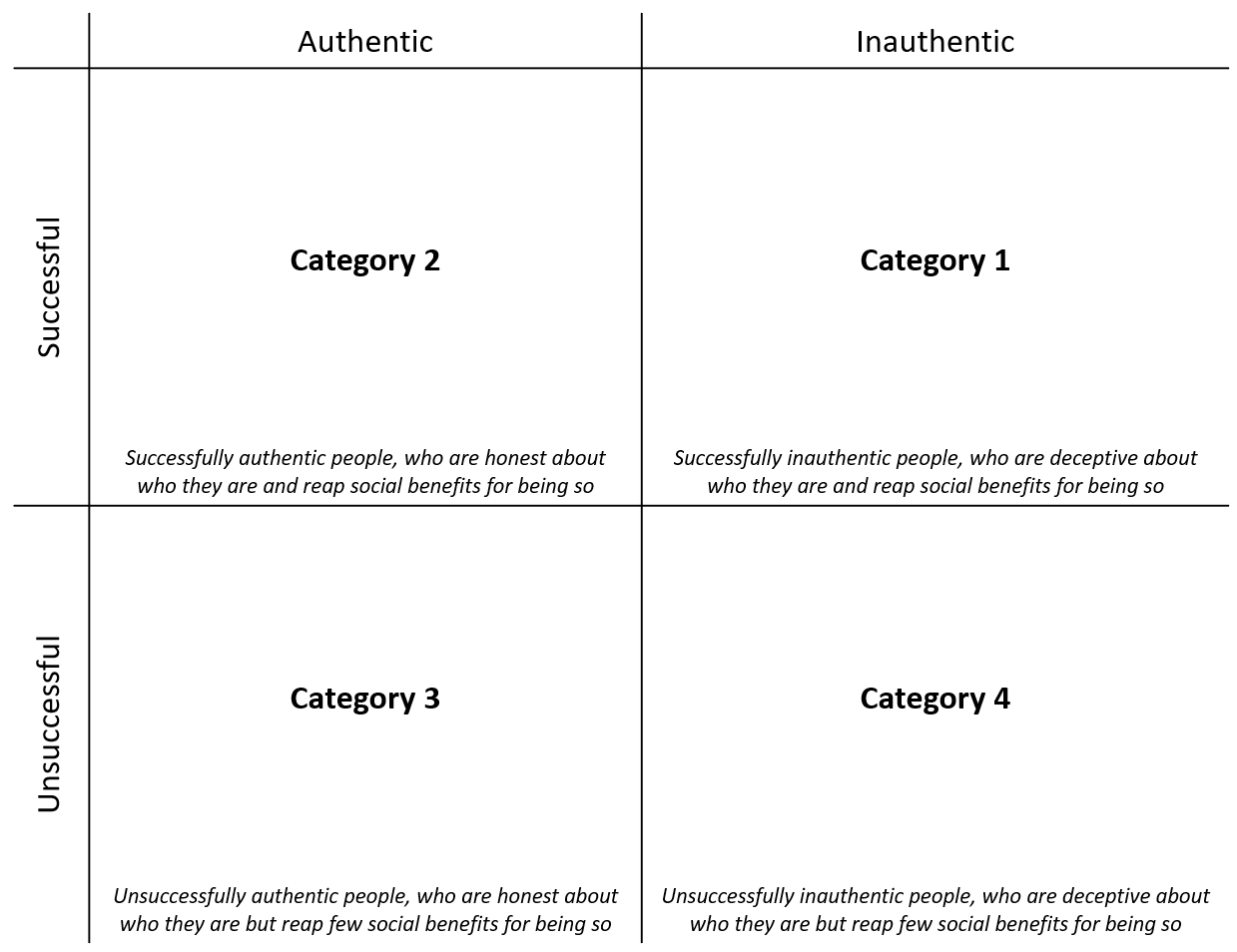
Category 2 individuals have few reasons to consider alternative strategies: things are working out great for them, and change is risky and costly. Of course, life could always be better, and so they will still strive for even more authenticity and more success, but without switching to another category. Category 1 individuals have more reasons to change, given that deception is cognitively costly and authenticity is far more enriching and rewarding than inauthenticity. Category 3 and 4 individuals both desire change given that they are unsuccessful, but the directionality of the change they might set upon depends on their outlook in life. This combination of life outlook and current position in life results in different narrative arcs which make up the backbone of all self-improvement theories.
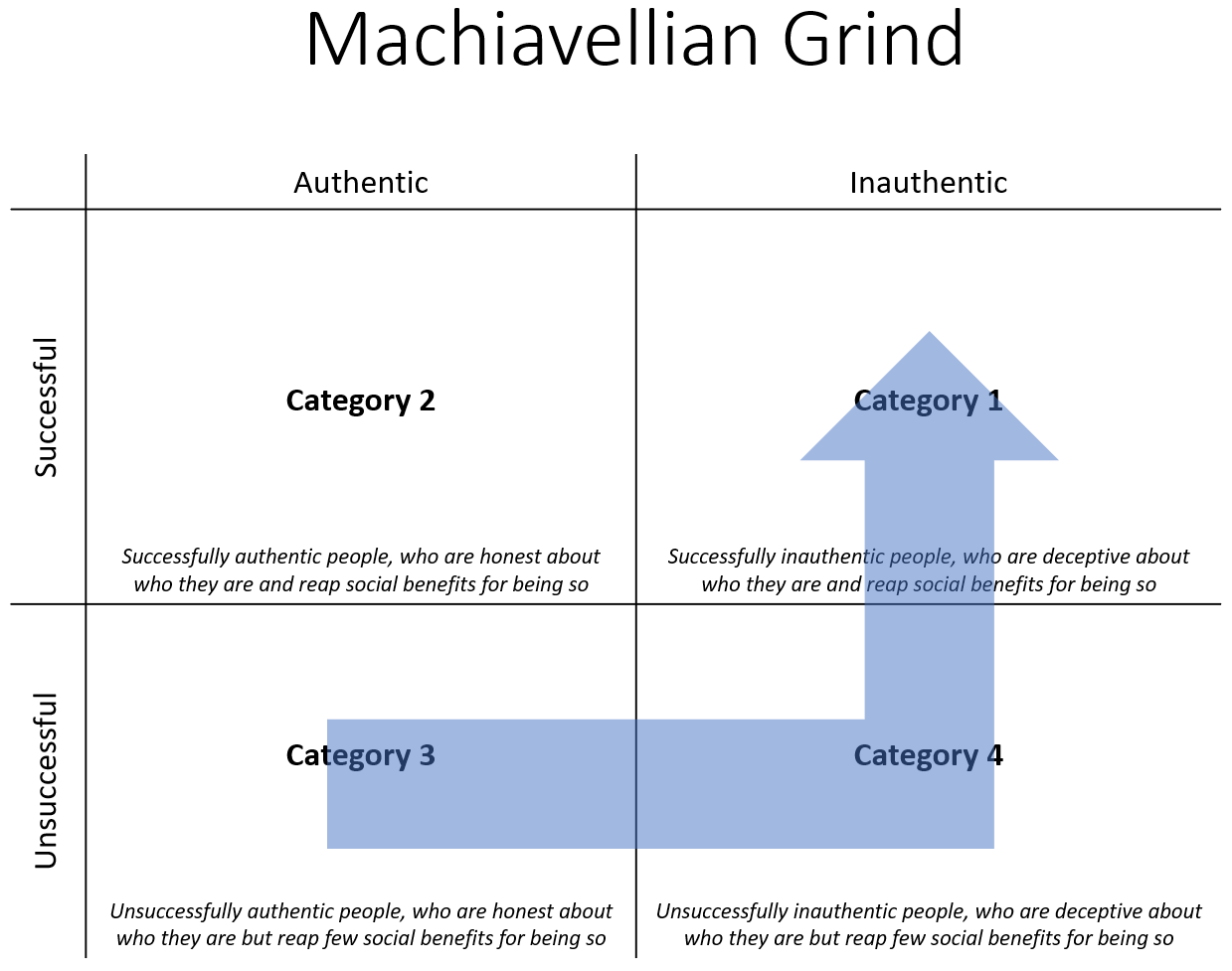
For instance, category 3 individuals who come to believe that their problem is that they are not cunning enough will attempt to become category 1 individuals by moving through category 2 (i.e. they will hone the craft of inauthenticity until they attain success through inauthenticity). A lot of business and dating advice falls into this category, and most of the demand for quick-fix tips and tricks is met by this sort of advice.
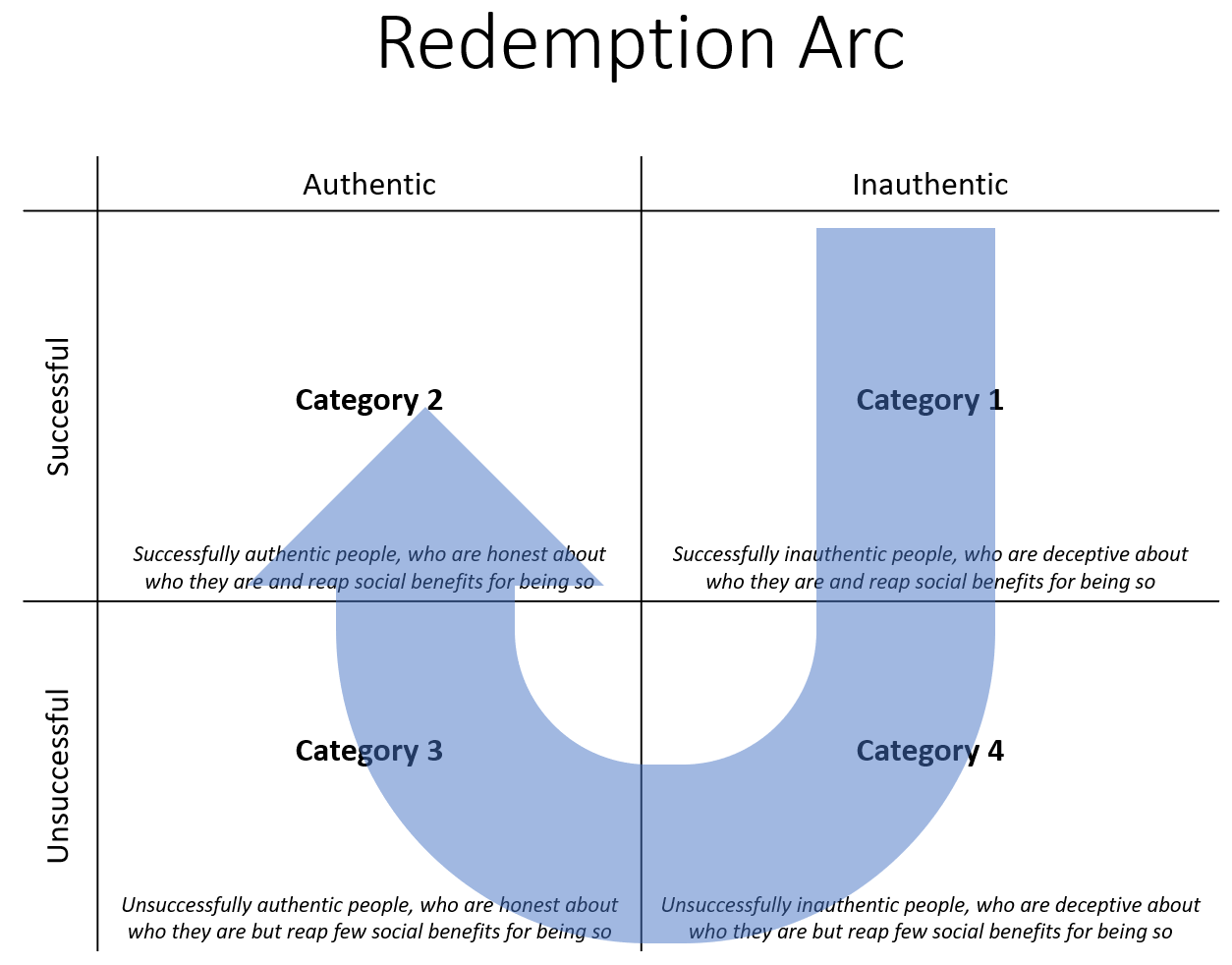
The inverse is also possible: a category 1 individual becomes disillusioned with the inauthentic life, lets down all of their deceptive strategies, becomes a category 4 individual, but then finds redemption by becoming a category 3 individual and then gradually becoming a category 2 individual.
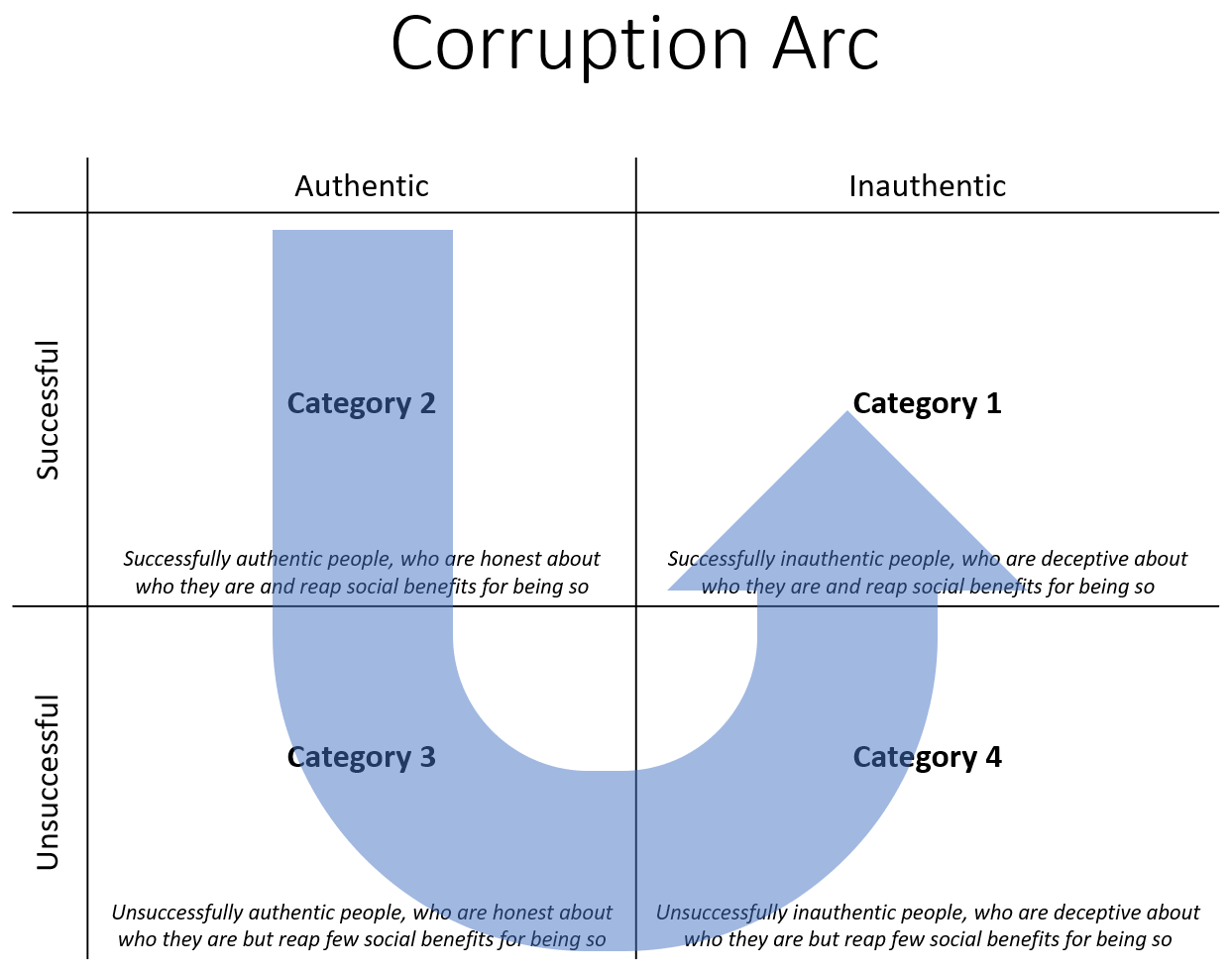
Most unsuccessful people self-identify as category 3 individuals: they are being themselves, but life is hard and people don’t like them; perhaps they have some particular unattractive traits which they have identified about themselves like being short, ugly, poor, boring, socially awkward, and so on, which they cite as aspects of their self about which being honest has brought them no success. They would change if they could, they say, but they can only do so much, and they need additional help in the form of tips and tricks for marketing themselves. But the fact is that most people belong in categories 1 and 4. Most people are inauthentic and don’t even know it. Authenticity in grown ups is rare and difficult, and total authenticity is an aspect of sainthood and genius alike. Authenticity is as attractive as it is rare.
Inauthenticity in and of itself is unattractive: humans have evolved to respond with disgust towards it; a part of the evolutionary arms race between deceivers and detectors. Hence, if you don’t get it, you don’t deserve it. If the advice to “just be yourself” is baffling, chances are that, not only are you displeasing, but you also tend towards deception and inauthenticity in response to that fact. Like the caught thief, you deserve the negative reaction you get for your inauthenticity. And in spite of the straightforward praise for authenticity, it is anything but a guarantee of success. Otherwise we would not have developed alternative strategies that are not only more costly but also more risky. You also “deserve” negative reactions you get for expressing your authentic self. However, there are several symmetry-breaking benefits to authenticity, positive or negative.
One benefit of authenticity is that it elicits true feedback with useful information. By true, I mean that there is a straightforward linkage between the word (namely, your name) and the object (namely, your being); by useful, I mean that the information which you gain from interacting with others can be applied to the way you live your life in a way that is enriching and fulfilling. Given that most people would accept that successful authenticity is possible, most people can accept that authentic self-improvement is good, and not futile. Hence, even negative reactions you get for being your authentic self is good for you, because they can help you become a better person. Of course, this is not to suggest a naïve collectivist social ethics in which one must conform faithfully to the demands of others. Far from it. The choice of whether to insistently be yourself only ever emerges in full when one faces up to the vulnerable act of revealing one’s authentic self to the world, and reckoning with its consequences. Inauthenticity is self-denial. Inauthenticity elicits useful feedback only to the extent that the feedback helps to inform you how to be more convincing in your deception. But the odds are always stacked against the inauthentic person: reality is always more complex than the simulation, and nowhere is this more true than in simulations of minds involved in the tactics of inauthenticity; being authentic is far less costly and far more “convincing” than being inauthentic whilst trying to convince others that you are being authentic. The brute physical fact that brains can handle so much computation puts a ceiling on how much simulation it can handle. Ironically, a limited capacity to simulate minds is precisely the cause behind juvenile delusions of grandeur about being so much smarter than others that one can get away with being wasteful with one’s computational resources. Not to mention that the brain, including one’s own, is part of the very reality being simulated, making it impossible that this particular chunk of reality can ever fit inside its simulation. You would need to be a god to do such a thing. One need only to ask: if you’re so smart, why haven’t you figured out how to find people on your level whom you can connect with genuinely? It never turns out that you are speaking to a god.
Another benefit of authenticity is its intrinsic value to oneself and to others. This benefit is closely tied to the benefit of true and useful feedback: trust and communication gives groups a potent advantage over those that lack trust or communication. But beyond this practical and evolutionary explanation, there is also the inherent joy and beauty of authenticity. Authenticity entails the expression of deep self-awareness and a communicative ethical regard for others. One must be deeply in touch with oneself; have a compassionate awareness of not only one’s conscious self, but also one’s subconscious mind; thoughtfulness and an earnest interest in the possibility of mutual understanding; the strength of character to resist the temptation of self-deception and self-denial, whether for selfish purposes or for the appeasement of others; and an attitude of exaltation towards the right to authenticity itself. All of these traits are admirable in a person. Authenticity is wonderful to behold, and to recognise it in someone is to be charmed. To experience it in oneself, to express it to others, to be deeply understood and to understand others deeply in kind, enable a form of connection entirely out of reach for inauthentic people. Not only is it instrumentally valuable because it gets you closer to successful authenticity, but it is rewarding and fulfilling in and of itself, even though it makes you vulnerable and comes with its own risk of hurt and disappointment. And since feedback for authenticity is true and useful, even the hurt and disappointment are valuable; when they come as a consequence of authenticity, they are valuable information about yourself, such as what sort of people are right for you or what your deepest values are.
The third benefit of authenticity is that, like inauthenticity, it is self-reinforcing. The practice of authenticity makes you better at being more authentic; the practice of inauthenticity makes you better at being more inauthentic. Another popular piece of advice, in total opposition to “just be yourself,” tells you to “fake it until you make it.” But, because authenticity and inauthenticity are both self-reinforcing, and each is opposed to another, faking it will only ever get you further from making it, if “making it” means to ultimately embody whatever virtues you are faking. The correct approach is to think at a meta level: instead of mimicking traits that are deemed attractive, conceptualise the lack of those traits as a symptom of some causally prior issue; hypothesise what that issue might be, and work on them, until it comes naturally to you to possess and express those attractive traits. The very fact of those traits being relied upon by people to detect authentic goodness is a sign of their reliability as symptoms of characterological well-being; it is seriously unwise to hide such valuable clues about who you are from others and yourself. Instead, they should be used as a gauge of progress in self-improvement. Don’t make yourself talk to people when you don’t want to, because you want to exhibit signs of sociability; become sociable, so that you naturally desire social interaction. Of course, a major component of such personal growth is embodied: acquired taste is acquired by tasting foods even though you dislike them at first. Then do that. Do talk to people even when you don’t want to. This does not contradict the former advice to not do that, because the reasons are different, which means the psychology is also different; hence, they are not the same actions. Selectively covering up symptoms of some flaw or shortcoming may increase your chances of fooling people by evading detection, but it means every social interaction will become a minefield-navigating test of your performance as an (ostensibly) authentically good and healthy person. Not only is that computationally expensive for your brain, it is also creepy, and the inauthentic individual deserves to be met with negative reactions when their interlocutor notices that something is amiss. Having inauthentic friends is bad for one’s practice of authenticity; having bad friends is bad for one’s moral health. And few things are so bad for one’s well-being as narcissists, radically inauthentic individuals who deceive even themselves. They seek to use other people for the express purpose of reinforcing that self-deception. There is no “making it” through the path of more elaborate inauthenticity; only the self-deception along the lines of pretending to oneself that one has finally become authentic through perfecting one’s performance.
There is yet another asymmetry between authenticity and inauthenticity, which stems from the additional benefits conferred to authentic individuals. Both authentic and inauthentic people are drawn to authentic people, to the extent that authenticity is intrinsically valuable and is associated with other pleasant traits. A parasitic strategy develops in any mixed population of authentic and inauthentic individuals, reminiscent of the “hawks” and “doves” game (wherein the violent hawks thrive when they are the minority amidst the peaceful doves, but dwindle when they are the majority, giving way to more doves). Presumably, inauthentic individuals can make a killing in the short term by deceiving authentic individuals possessing various desirable qualities and resources which the latter have built up through the much more costly process of genuine self-improvement. Spending an hour learning the right few turns of phrase and feigning advanced industry knowledge will net the salesman far more closed deals than had they spent that hour learning the basics of the industry. The fact that people hate poseurs is evidence of the fact that they are convincing enough to profit from putting on an act, and costly enough to detect and deter that it’s often strategically viable. But parasitism is despised for more reasons than mere moral disgust; namely, that it is wasteful for the host to permit it. Not only is inauthenticity rightfully met with contempt, but it is hunted down with material motivation by authentic individuals, so that it can be discouraged either through education or ostracisation. While the markers of authenticity are pleasant to experience, much of their value comes from the substance signaled by these markers. You can memorise the names of bands or even develop technical abilities with instruments all you want, but if you lack genuine love for music and a care for the community, other musicians will find that creative collaboration with you is barren and discouraging. There are far too many ineffable ingredients that go into creative connections for one to ever be entitled to successful collaboration merely by checking some boxes. Once again, the natural response to such inauthenticity is disgust; disgust is a gut reaction that should be cultivated for the purposes of detecting inauthenticity.
Unfortunately, we live in a world where inauthenticity is frequently a necessity. A striking sign of this fact is that many people respond with disgust towards authenticity. They cringe, get the ick, become embarrassed second-hand, or angry at the sight of authentic self-expression. It’s one thing to find particular traits repulsive; authenticity is not an overriding virtue that justifies other flaws, and someone could well be authentically evil. But hostility towards authenticity itself is surely a sign that an individual has internalised negative attitudes towards authenticity in general as well as their own authentic self in particular. Perhaps hiding one’s authentic self was a necessary strategy for them to survive in a dangerous home environment, and now they associate it with danger per se; perhaps other individuals who have similarly internalised such negative attitudes towards authenticity influenced them to adopt the same attitudes through showing disgust whenever this individual showed their own authentic self; perhaps they are not in the right place in life to be able to afford the ramifications of having to switch to an alternative strategy (from inauthenticity to authenticity), and are postponing it for now with the unconscious bias against authenticity. These cases are as understandable as they are unfortunate. Ideally, nobody in the world should have to be so repressed, in spite of the classical Freudian notion that such repression is the price we pay for peace and civilisation. That authenticity and inauthenticity are competing strategies demonstrates that a plurality of viable strategies are open to human beings; the utopian psychoanalytic vision of a totally authentic society, freed from the need for repression, is hardly an evolutionary impossibility, and instead a plausible future on the far horizon. The prescription is not so much to opt for radical honesty always and at all times, but to hold this sociological ideal in mind and cultivate communities and ways of life that promote and protect authenticity whilst ruthlessly disadvantaging manipulation, exploitation, and inauthenticity.
A far more benign case of the tendency towards inauthenticity is in play. Playing pretend is an integral aspect of child development, as well as throughout adulthood whenever new practices and identities are being adopted. To learn a new language, to be inducted into a new culture, to consider a new way of thinking: all of these things require playing pretend as a way of trying out new modes of being; and to connect deeply with a new person is to undergo all these different kinds of learning and more. Even more than the acquisition of taste, these are ways to discover new faculties altogether, extending one’s self into the world. And the potential for growth and development is an integral aspect of anybody’s authentic being. The self is not essential, it is processual: it is the meta-level freedom regarding the directionality of one’s life that is the essence of free will, not a reckless indulgence of desires, including the desire for stasis. Just as the choice to insistently, authentically be oneself only emerges when one faces up to the consequences of vulnerable self-expression, the possibility of authentic being itself is closed to those who cannot play with their own identity and ways of life. To be so conservative is to deny one’s self through the insistence that one is one’s self of the past, all the while denying the existence of the self who is engaging in this very denial. The authentic self responds dynamically to both the internal and external feedback they receive for their self-expression. It changes.
It may be jarring to see this combination of apparently individualistic ethics of authenticity (namely, that one always deserves the consequences of authentic self-expression in some sense) coupled with the very much collectivistic ethics of the authentic society (namely, that we must work together towards a world in which authenticity achieves total strategic dominance). Most popular philosophical accounts of authenticity are individualistic in a way that pits the individual person against society at large: Emerson proclaims in his wonderful essay “Self-Reliance” that, “if I am the devil’s child, I will live then from the devil”; the devil himself in Milton’s Paradise Lost claims that it is “better to reign in Hell, than to serve in Heaven”; Nietzsche’s prescription in The Anti-Christ is to reject the institution of compassionate ethics in favour of what he considers an honest description of morality as a proxy for the struggle for power between all things and individuals, and to argue for individuality as a necessary condition for the ethical significance of the creative genius elites; Sartre, in his Being and Nothingness, democratises Nietzsche’s elitist ethics by arguing that each and every human being is ontologically and necessarily free, because every action implies desire as its causal motivation (which, as the very fact of action proves, successfully motivated the action), and must therefore bear responsibility for their choice to act in some way; and Freud’s theories of neurosis and its treatment is thoroughly focused on the internal mechanics of the individual patient, and it is only with the socially-oriented left-wing Post-Freudians such as Fromm, Horney, and Sullivan that a socially oriented understanding of the individual was established within psychoanalysis; in Adler’s hands, Freud’s biologically grounded theory of the mind becomes infused with a kind of somatised Nietzschean Will to Power, wherein striving superiority comes to explain both behaviours such as choice of career (perhaps advanced into as a strategy to attain superiority) and physiological phenomena such as illness (often retreated into as a strategy to excuse one’s inferiority).
In the even further watered down accounts of such popular philosophies within the genre of self-help and self-improvement, these philosophers are evoked primarily for their quotability, their motivational speech qualities. The Stoics tell you to suck it up in retrofitted therapy speak; the existentialists tell you to stop being angsty and just pick your poison already; and the Buddhists tell you that your own thoughts and feelings aren’t that deep. This is just as well if you take it as what it is. A bit of Emersonian entrepreneurial spirit, or a spot of Nietzschean audacity, or some Adlerian self-reflection about unconscious strategies can all help someone to become better at being more creatively free, and therefore more authentic. If it works, it is useful, and it is good to that narrow, therapeutic extent. There’s nothing wrong with personal responsibility, independence, and autonomy. It’s vital to human well-being. In that sense, even Ayn Rand is good self-help for those in need of a Nietzschean heroism that replaces creative genius with an expertise in trains, money, and architecture. Life is hard and the bar is low. But the private mental health and personal freedom of the individual are only a small part of all the good that is possible in the world. And much of even individual health and freedom are threatened and blockaded, because most societies are variously hostile environments towards authentic individuals. A sure sign that none of these shallow treatments of self-improvement that focus on symptom-focused, palliative care work very well, is the endless demand for novelty in self-help content itself. When the excitement of listening to an Alan Watts lecture clip set to movie soundtracks or a Marcus Aurelius workout montage video runs dry, you have to turn to harder stuff like readings from Yukio Mishima’s Sun and Steel or Nietzsche again but with quotes curated by a more esoteric poster. But this search for the bit of wisdom that finally works seldom leads anywhere, precisely because they lack the wisdom to guide their search.
The stereotypically unwise individual demands instant, guaranteed results. They want to try out a quick-fix tip and see that it did the trick. Freud believed that human impulses were the outcome of a negotiation between the pleasure principle (the Id’s demand for immediate gratification) and the reality principle (the Ego’s tampering of the Id based on the limitations encountered through lived experience). The growing influence of the reality principle in an individual is, for Freud, a vital part of growing up. And, according to Freud, neurotics variously fall short in facing reality: neurosis is a partial failure of repression of the Id by the Ego; psychosis is a total failure. Freud also suggests that even healthy individuals are somewhat neurotic, although to a far more manageable extent. And as Nietzsche suggests, there is a neurosis of health also, in which preoccupation with healthiness in and of itself becomes a neurosis. Conscientious and sceptical individuals, obsessed with rationality, can be just as unwise as neurotics, whose inner demand for pleasurable self-deception has overpowered their attempts to face, and compromise with, reality. Perhaps they insist on peer-reviewed research (or meta-analyses) supporting the advice, or decide to track a metric for progress and see whether something worked. Perhaps they think feelings must always concede to facts, whether you’re deciding on what to eat, how to create art, or whom you befriend. But population studies are ultimately zoomed out and stratified collections of case studies without the intimacy of case studies, and the complexity of your individual self can never be fully represented through data alone. That’s why your mother telling you to eat healthy based on “anecdotal evidence” is wiser than you insisting that calories are calories and all you need to do is count your macros. That something works for you is the ultimate defeater. To deny this is a neurotic denial of reality as pertains to your private experience, in favour of some fantasy of being a disembodied being of pure reason and objectivity. Thus, authenticity is not mere truth-telling, particularly given that the mind is as much characterised by self-concealment and self-deception as it is by the fact that each individual has some privileged access to their own mind. Hence, post-Freudian analysts such as Lacan suggest that fantasies are integral to the very contact with reality facilitated by the reality principle. Whether in trying on a new identity like a costume with which to negotiate contact with social reality, or in being inducted into a new paradigm within which to engage in scientific research, play and imagination are integral to the development of a richer understanding and expression of the self. Authenticity is, therefore, often a prerequisite to the capacity to tell the truth: one cannot be familiar with oneself enough to know the truth about oneself without the practice of authenticity.
Besides the fact that both wanton indulgence of fantasies and dogmatic rationalism both amount to inauthenticity, there are more reasons still to reject mere truth-telling as the royal road to authenticity. We frequently find that truth as a moral value is in conflict with other moral values, such as justice or beauty: we ought to lie if it means to save an innocent life; we ought to encourage artistic license that enables the production of great stories; we must tamper the temptation to turn truth into an overriding, categorical imperative, and allow for some degree of falsehoods in exchange for the benefit of other moral values. A neurotic fixation on a particular value such as truth is bad, both because it results in the neglect of other values, and also because it leads to an inauthentic mode of life; it belies an inability to play.
Although it is clear by now that authenticity is far preferable to inauthenticity, it may also seem like an impossible puzzle with no beginning or end: I have argued first that authenticity is to be preferred over inauthenticity for strategic reasons, and for ethical reasons too, but revealed that the full development of authenticity requires various additional components such as a continued practice of self experimentation and an ethical philosophy to guide one’s life, which, in turn, require authenticity to properly engage in. It is difficult to identify a point of entry into such a complex feedback system. But existence itself is an impossible puzzle with no beginning or end. Luckily, it is also a self-solving puzzle that unravels itself the more you work at it, regardless of how and where you start. Authenticity begets more authenticity, both for the individual person and for a community. Being authentic about one aspect of your life will make it easier to be authentic about other aspects of your life, and being more authentic will attract other authentic individuals who can help you become more authentic. It will help you learn more about yourself and reality, and to better negotiate between the two, prompting new insights and changes for the better. So, now you see that this is the only bit of “social skill” advice worth giving, and the only one that anybody deserves: Just be yourself, bro.